

Hiring is one of the most critical functions in any organization, yet the systems supporting it have remained largely unchanged. Most companies today rely on traditional Applicant Tracking Systems (ATS) that were designed to manage applicants, not to improve hiring outcomes. As a result, recruiters are left navigating high volumes of candidates with tools that prioritize tracking over decision-making.
While organizations invest heavily in attracting talent, the systems used to process that talent often introduce inefficiencies—slowing down hiring, increasing manual effort, and making it harder to identify the right candidates consistently.
The Problem with Traditional ATS Systems
At their core, most ATS platforms function as storage and workflow tools. They help organize resumes, track candidate stages, and maintain records. While this was sufficient in the past, modern hiring demands far more.
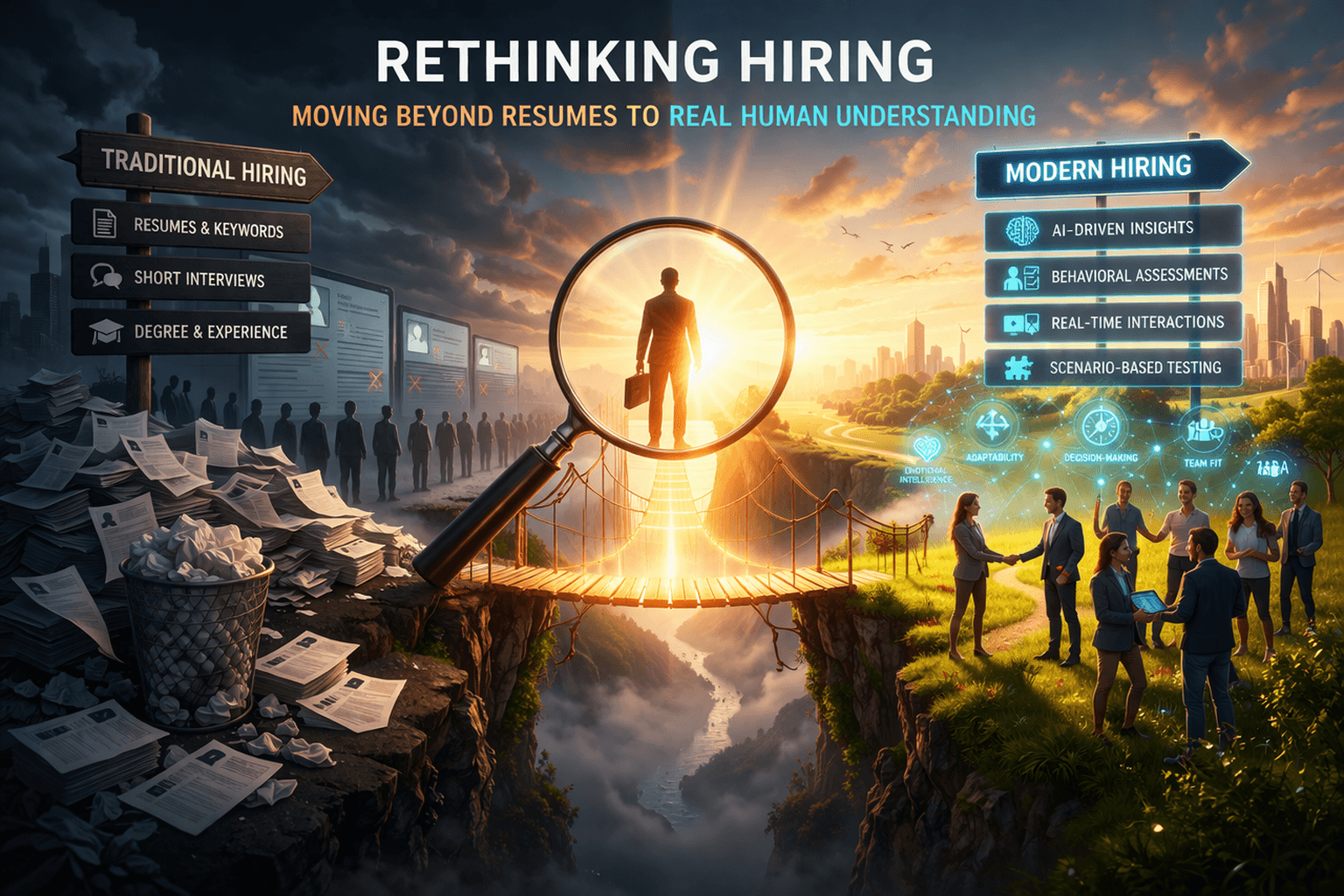
- Resume-Centric Evaluation: Relies on keyword matching and static resumes, often missing high-potential candidates.
- Manual Shortlisting Burden: Recruiters spend hours filtering and screening candidates.
- Lack of Contextual Insights: Limited understanding of behavior, adaptability, and fit.
- Disconnected Hiring Workflow: Feedback and evaluations are scattered.
- Pipeline Without Intelligence: Shows progress, but not who should move forward or why.
The result is a system that tracks activity but doesn’t improve outcomes.
Why This Becomes a Bigger Problem Today
Hiring today is fundamentally different from a decade ago. Organizations deal with:
- Massive application volumes
- Faster hiring expectations
- Increased competition for talent
- Greater emphasis on quality of hire
In this environment, simply organizing candidates is not enough. Companies need systems that help them decide better, faster, and at scale.
Rethinking the Role of an ATS
The role of an ATS should not be limited to tracking applicants. It should act as a decision-support system that reduces effort, increases clarity, and improves hiring quality.
- From storing resumes → to understanding candidates
- From managing workflows → to guiding decisions
- From static data → to evolving insights
This is exactly the shift AuraSync ATS is built around.
How AuraSync ATS Addresses These Gaps
AuraSync ATS moves beyond traditional systems by introducing structure, intelligence, and continuity into the hiring process.
It builds structured candidate profiles that evolve throughout the hiring journey. Information is not just stored it is organized to make evaluation easier and more consistent.
The system reduces manual effort by streamlining candidate movement through stages, allowing recruiters to focus on decision-making instead of coordination.
All interactions—applications, feedback, and evaluations exist within a unified flow, eliminating fragmentation.
Collaboration improves as everyone works within the same system, with shared visibility and context, leading to better alignment and decisions.
Most importantly, AuraSync ATS transforms the pipeline into a structured decision environment that supports clarity and confidence.
Part of a Larger Hiring Ecosystem
Candidate Entry → ATS → Evaluation → CRM → Outcome
AuraSync ATS acts as the foundation where all candidate data flows, ensuring insights are carried forward into decision-making and business outcomes.
Why This Matters
The biggest challenge in hiring today is not access to talent it is the ability to identify the right talent efficiently.
- Reducing manual effort
- Bringing structure to complexity
- Enabling consistent evaluation
- Supporting faster, clearer decisions
Final Thought
The problem with most ATS platforms is not that they fail it’s that they stop too early. They help manage hiring, but they don’t help improve it.
AuraSync ATS bridges that gap by shifting from tracking applicants to enabling better hiring decisions creating a system that actively improves the process.